A website for a textile chemicals manufacturer: five ranges, six sections, one route to a trial
- Client
- AKS Chemicals
- Scope
- Rebuild, SEO, content
- Stack
- Next.js, static export
- Ranges
- 5, plus toll manufacturing
- Live
- akschemicals.com
Website redesign for a textile chemicals manufacturer
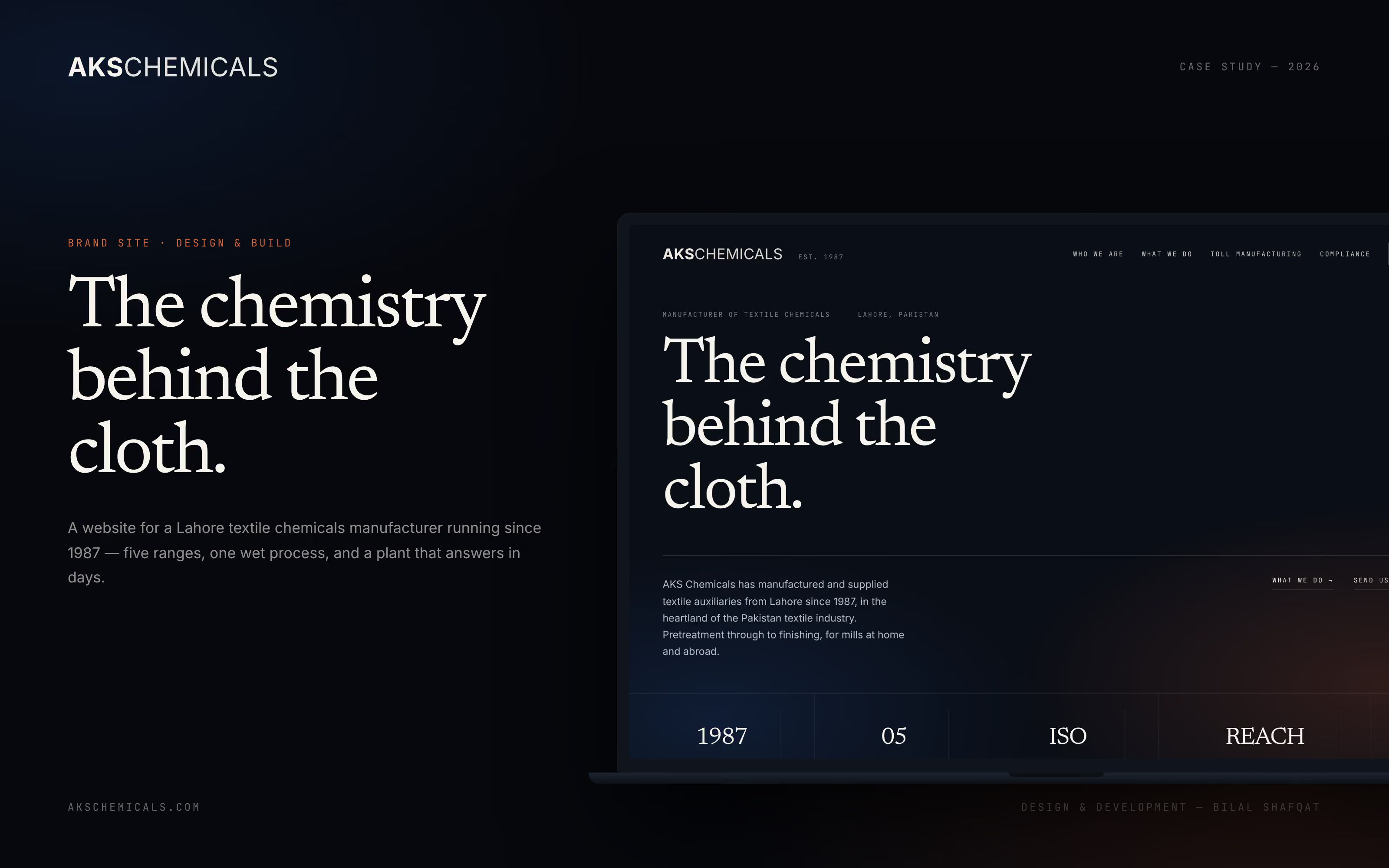
AKS Chemicals has made textile auxiliaries in Lahore since 1987, in the heartland of Pakistan's textile industry. The chemistry was never the problem. The problem was a dated WordPress site that said almost nothing about the five ranges, the plant, or the toll manufacturing service buyers actually come for.
The rebuild puts the wet process at the centre: a numbered sequence from who AKS is to what it makes, with the standards and the plant visible on the way through. A serif for authority, a monospace for precision, and photography from their own floor.
From a dated WordPress site in four phases
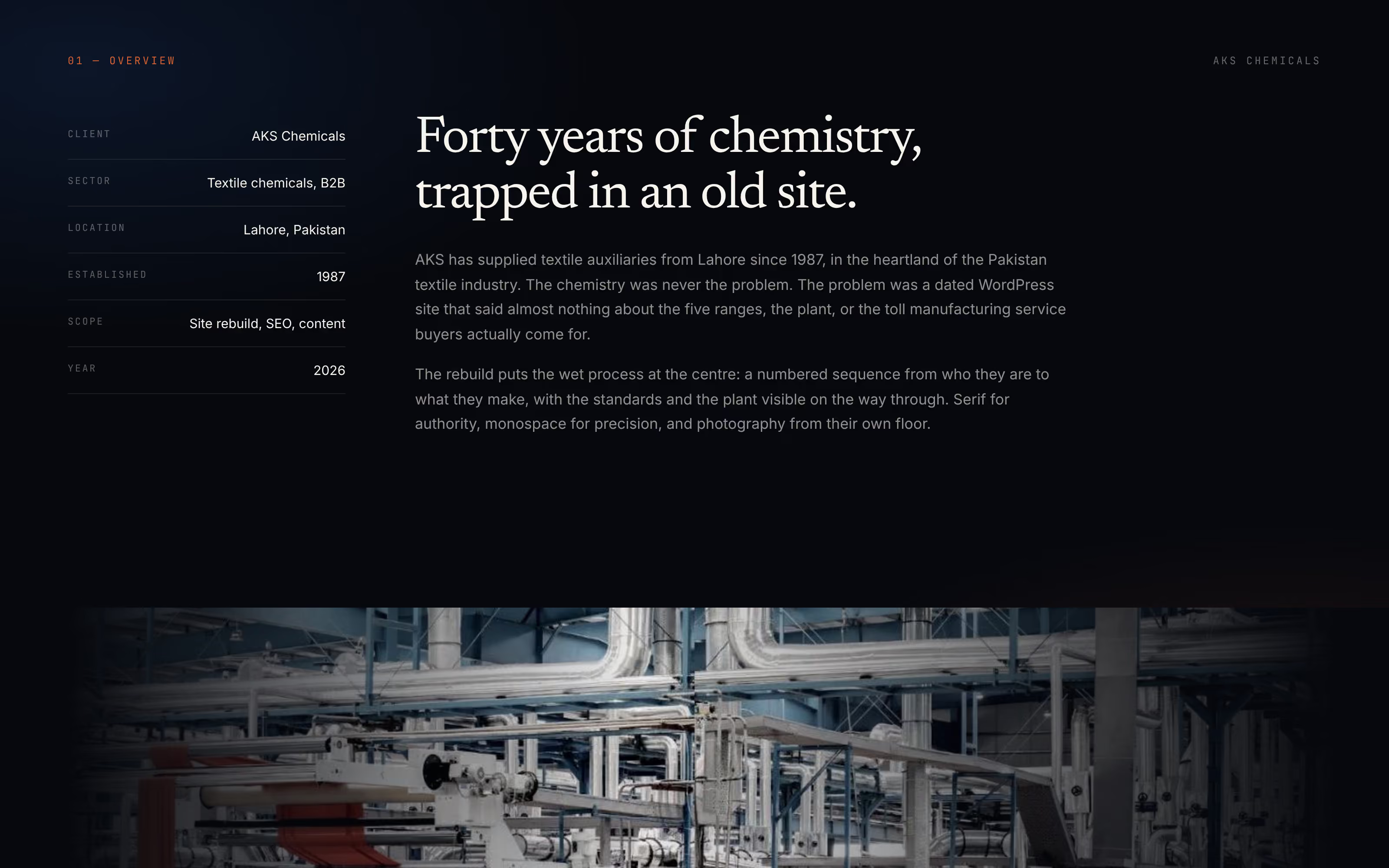
Each phase closed with something the client could use. The audit reviewed the old site, the buyers' needs and the search gaps, and produced a content map and rebuild brief. Structure set the five ranges, the toll service, compliance and the sitemap into a six-section page. Design produced the type system, the dark palette, the photography and a clickable prototype. Build and grow delivered the Next.js site, SEO, enquiry routing and content.
One decision shaped the rest: dark, not clinical. Every competitor sells white laboratories; AKS sells a plant that runs. The test for success was just as plain: a mill reads the ranges, trusts the standards and sends cloth.
A dark palette lit like a dye house
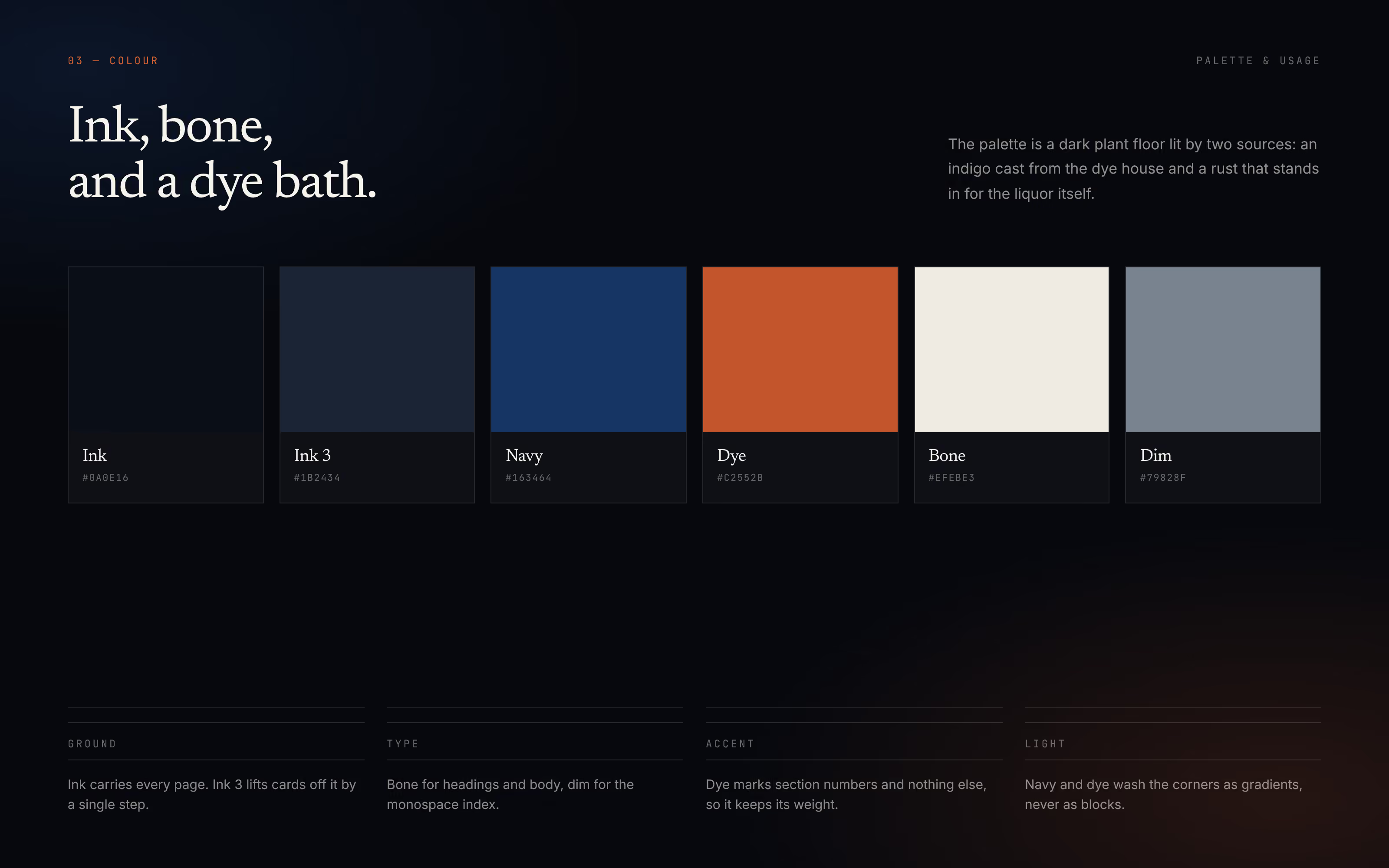
The palette is a dark plant floor lit by two sources: an indigo cast from the dye house and a rust that stands in for the dye liquor itself. Ink carries every page and a second ink lifts cards off it by one step. Bone is used for headings and body text, and a dim grey for the monospace index.
The rust is kept for section numbers and nothing else, so it keeps its weight. Navy and rust wash the corners as gradients, never as blocks. Six colours in total: ink #0A0E16, ink 3 #1B2434, navy #163464, dye #C2552B, bone #EFEBE3 and dim #79828F.
A serif for authority, a monospace for precision
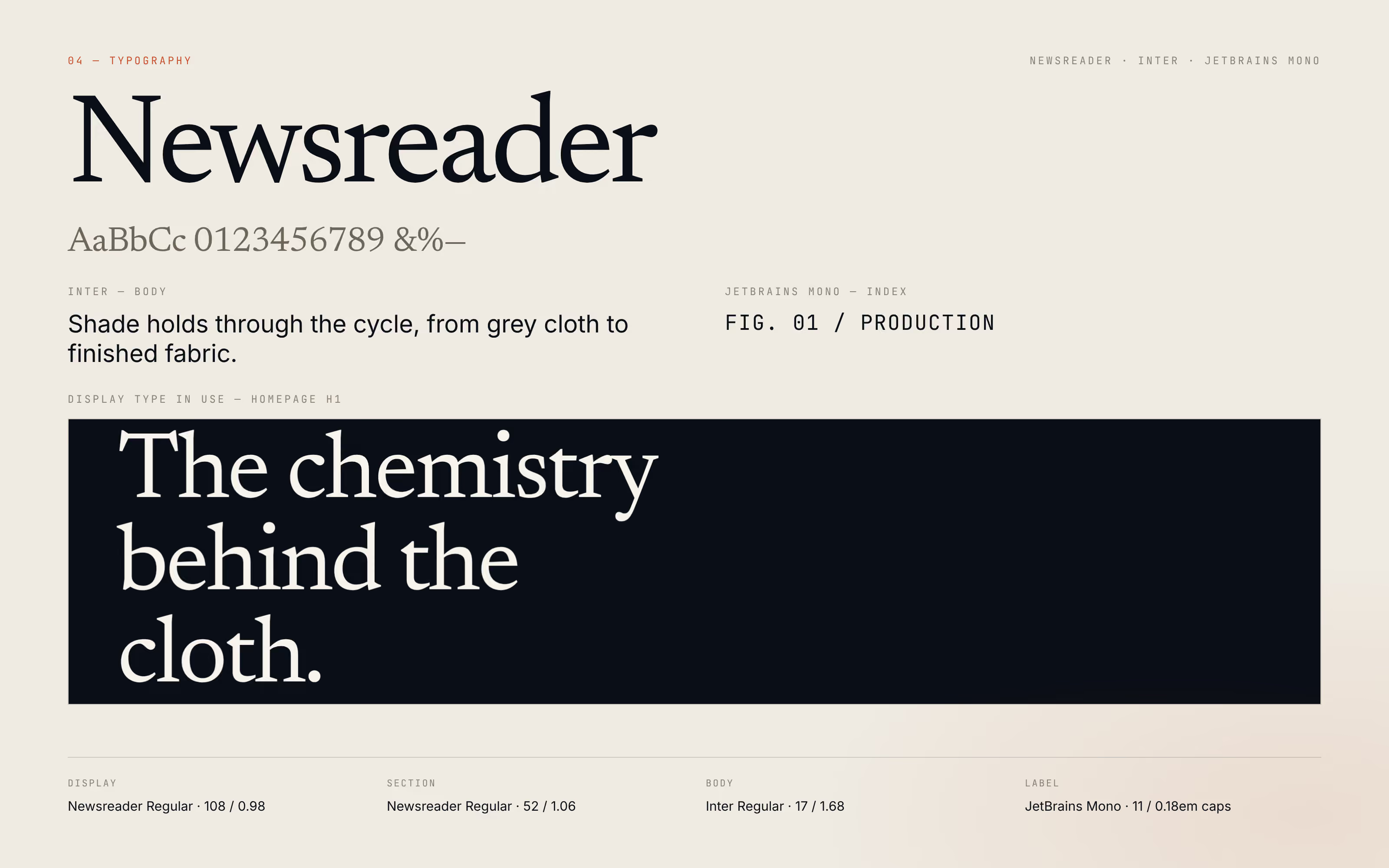
Newsreader sets the headlines, large and close, so the homepage opens like the front page of a technical journal rather than a template. Inter carries the body copy at 17px for easy reading. JetBrains Mono labels every figure, section and photograph in small spaced capitals.
The serif says the company has been doing this for decades. The monospace says it measures things. Together they suit a buyer who judges a supplier on whether it understands their process.
One line, then the numbers that back it
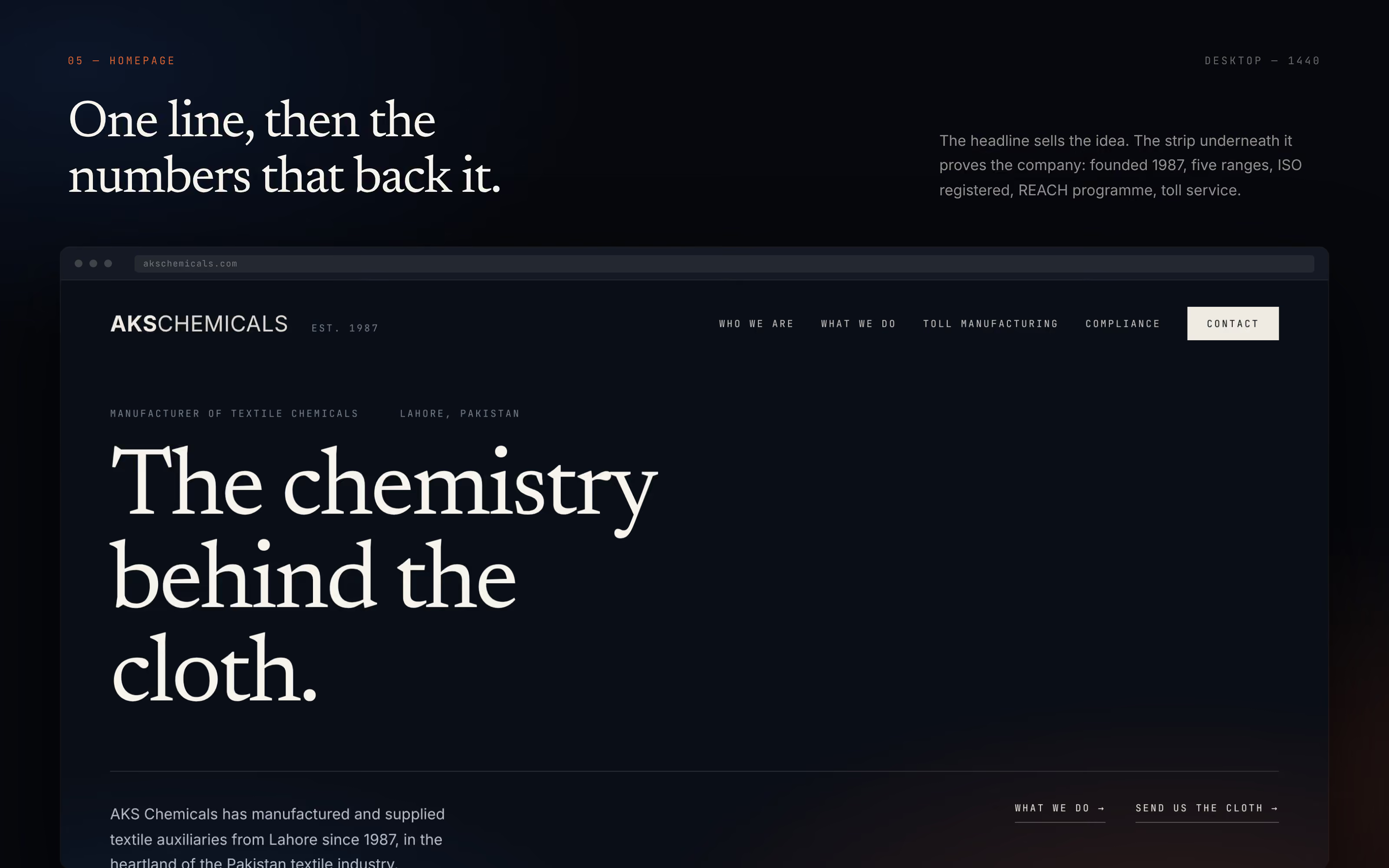
The headline sells the idea: The chemistry behind the cloth. The strip under it proves the company: founded 1987, five ranges, ISO registered, a REACH programme and a toll manufacturing service.
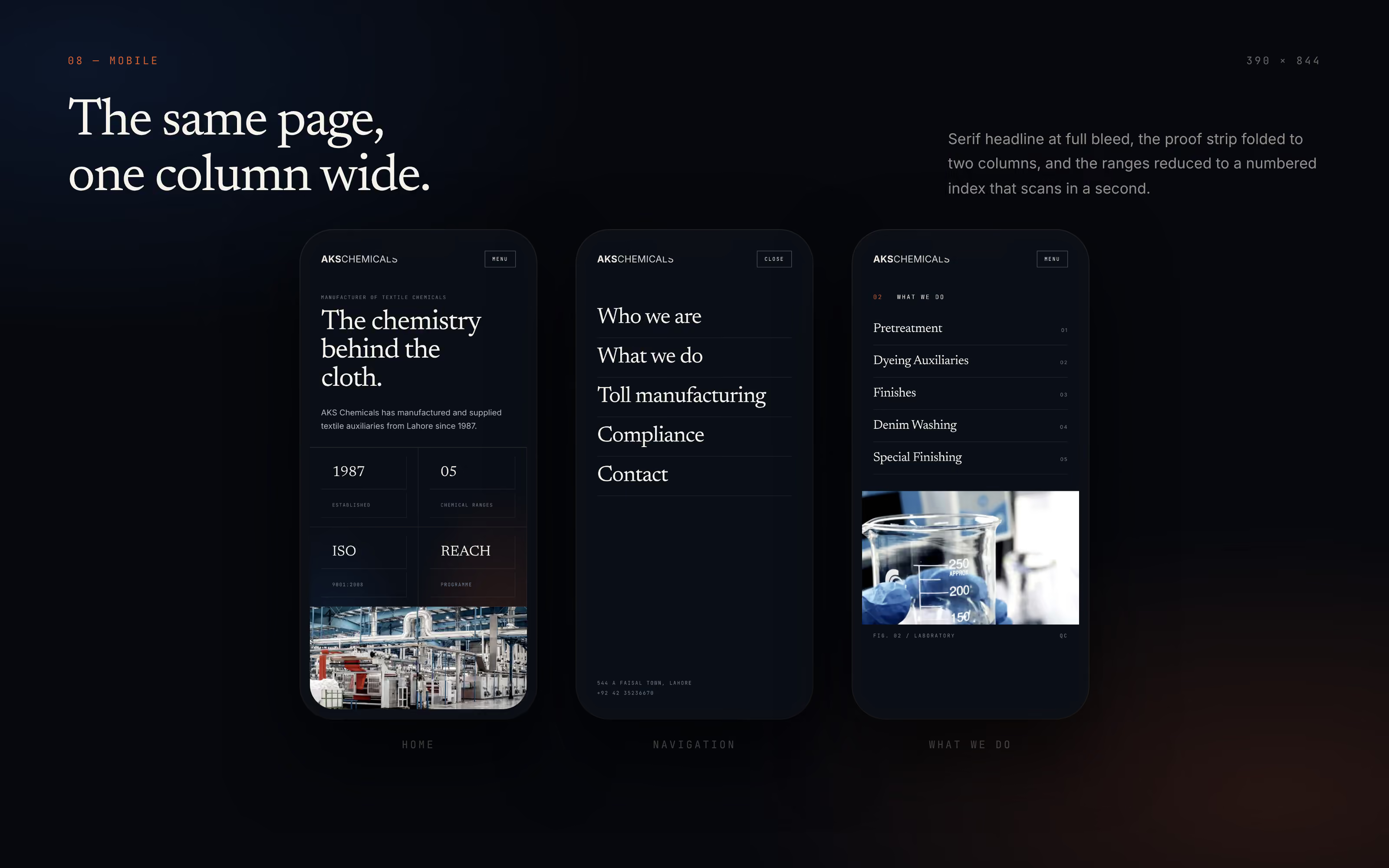
The navigation is five plain links, Who we are, What we do, Toll manufacturing, Compliance and Contact, and the two routes under the headline are What we do and Send us the cloth. A mill manager knows within one screen whether this is a supplier worth a trial.
Six sections, read in one scroll
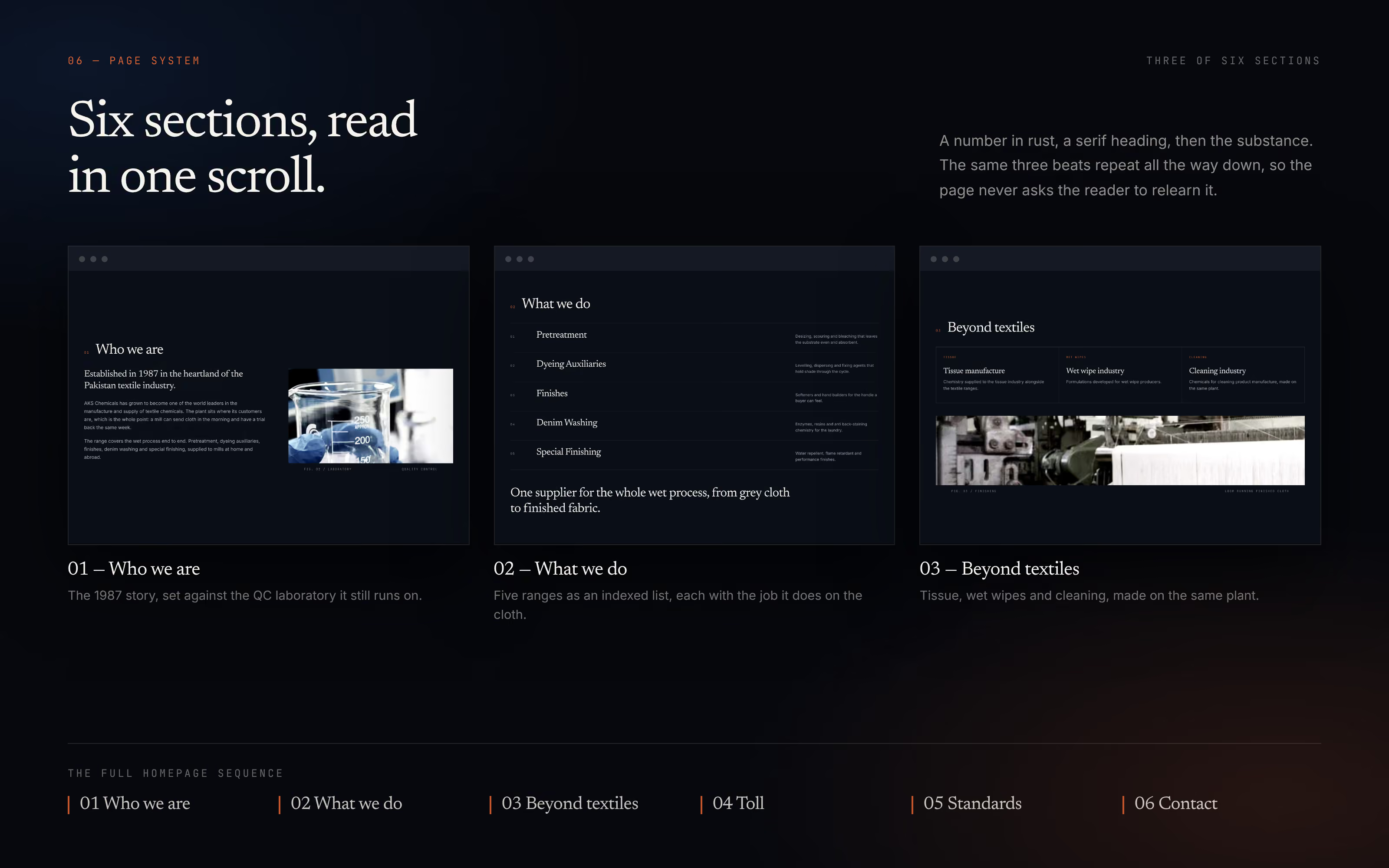
The homepage runs in six sections: Who we are, What we do, Beyond textiles, Toll, Standards and Contact. Each opens the same way, with a number in rust, a serif heading and then the substance, so the page never asks the reader to learn it again.
One page, six sections was a deliberate limit. A technical buyer scrolls once rather than hunting through a menu, and everything they need before an enquiry is on the way down.
Five ranges in the order cloth meets them
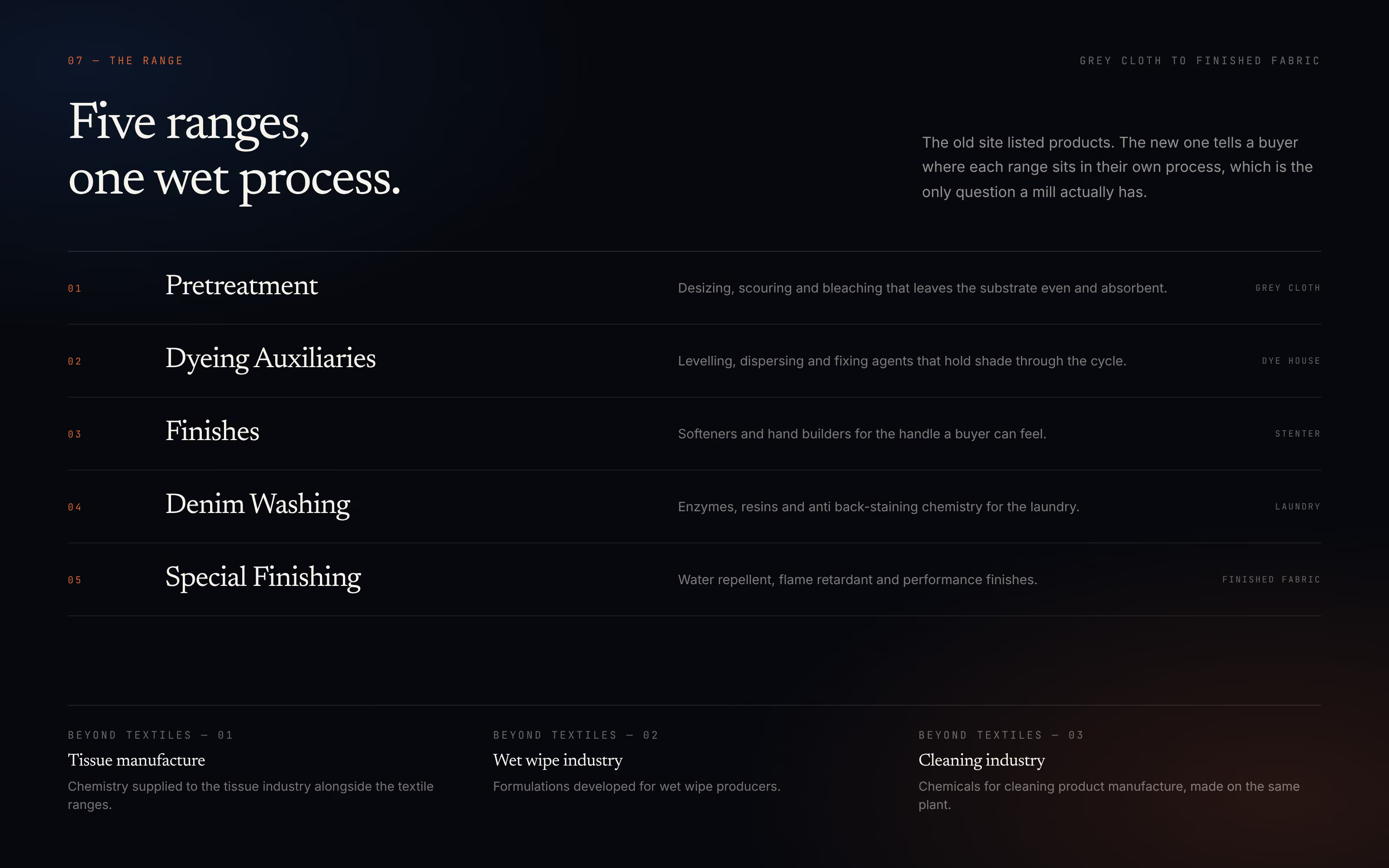
The old site listed products. The new one tells a buyer where each range sits in their own process, which is the only question a mill actually has. Pretreatment for grey cloth, dyeing auxiliaries for the dye house, finishes for the stenter, denim washing for the laundry and special finishing for the finished fabric.
Below the ranges sit the markets beyond textiles: chemistry for tissue manufacture, formulations for wet wipe producers and chemicals for cleaning products, made on the same plant.
The same page, one column wide
On a phone the serif headline runs at full width, the proof strip folds into two columns, and the five ranges become a numbered index that can be read in a second.
The menu opens to five large links in the same serif, with the works address and phone numbers at the foot, so a buyer standing at a machine can call the plant without looking for a contact page.
Toll manufacturing, standards and the enquiry form
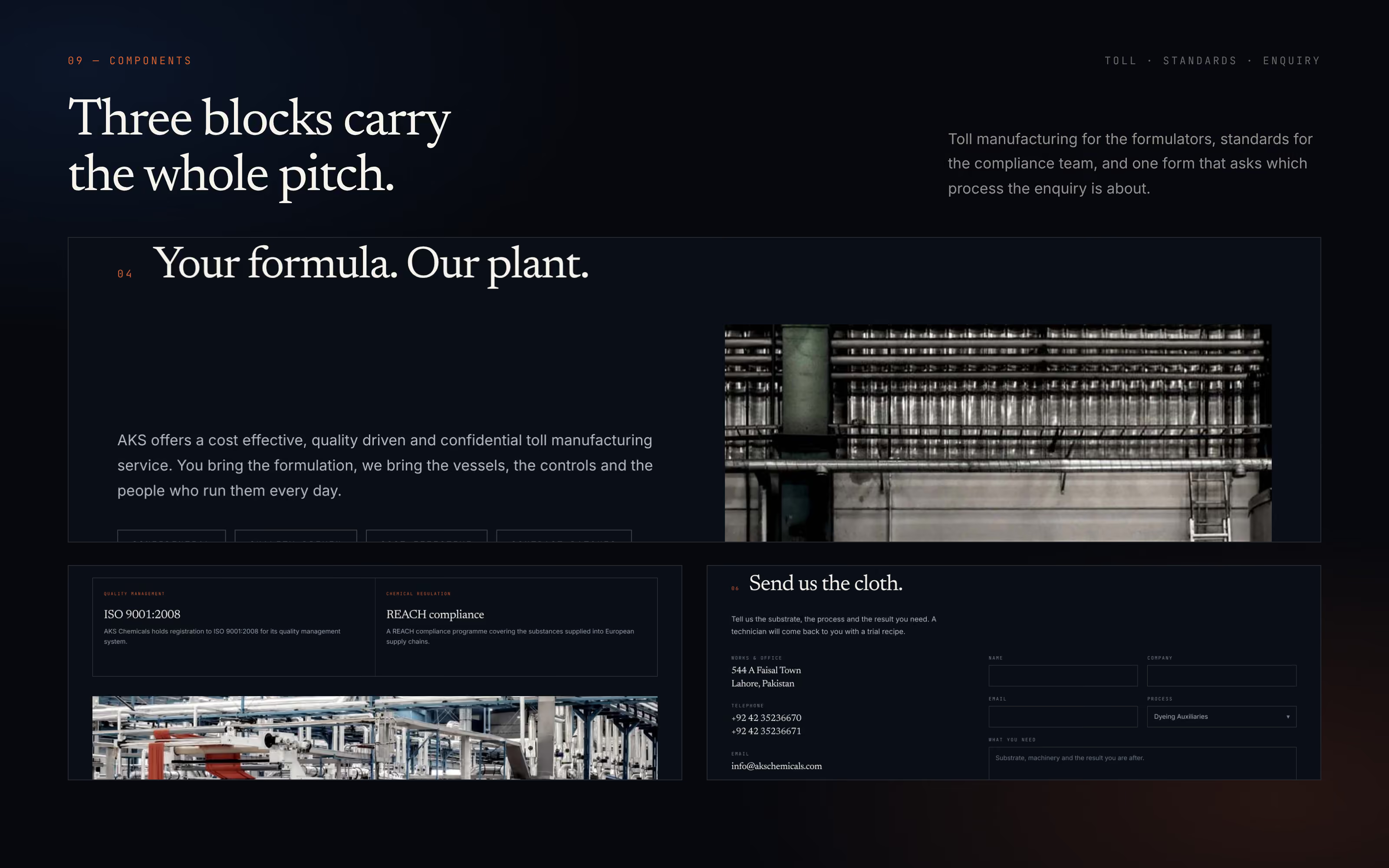
Three blocks carry the whole pitch. Toll manufacturing, under the line Your formula. Our plant., speaks to formulators who want their own product made confidentially. Standards gives the compliance team ISO 9001:2008 and the REACH programme up front.
The enquiry form, headed Send us the cloth, asks for the substrate, the process and the result the mill needs, and says what happens next: a technician comes back with a trial recipe. Each enquiry arrives already tagged with its process.
A plant that finally looks like itself
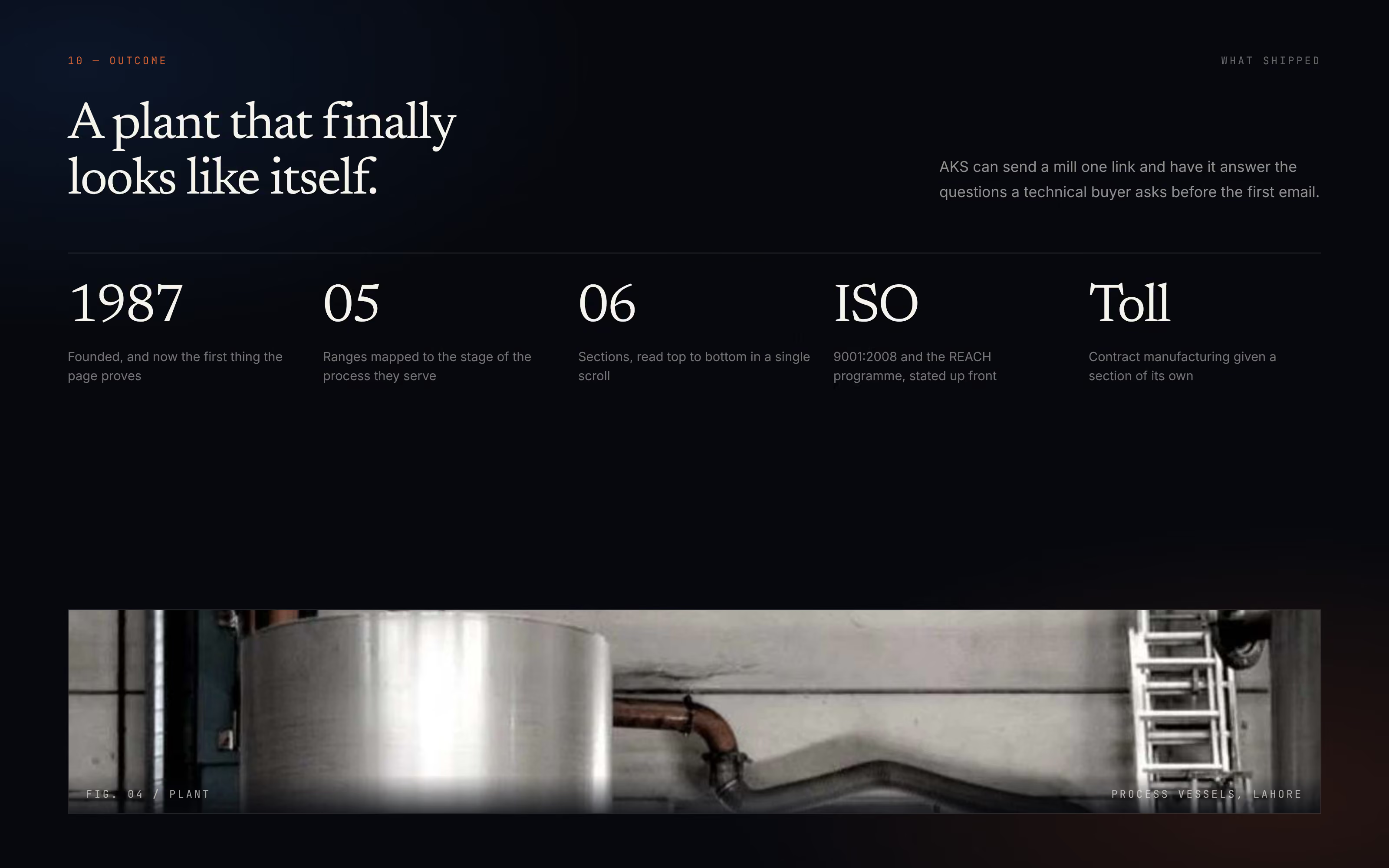
What shipped: the 1987 founding as the first thing the page proves, five ranges mapped to the stage of the process they serve, six sections read in one scroll, ISO 9001:2008 and REACH stated up front, and toll manufacturing given a section of its own. AKS can now send a mill one link and have it answer the questions a technical buyer asks before the first email.
The site is also the base for the rest of the marketing. The Google and Meta campaigns, SEO and AI search work all point at these pages, and every old WordPress address redirects to its new page, so the rankings the old site earned carry over.
Is your website doing your plant justice?
I design and build websites for manufacturers and B2B companies, where the buyer is a technician and the process is the product. One person from the first sketch to the live site, and the campaigns after it.
About this website
Why replace a working WordPress site?
The old site depended on a page builder and plugins that needed regular updates, and most of its content dated from 2021. The new site is static files with nothing to patch, loads quickly on a phone, and keeps every product range and contact detail in one place, so it stays accurate as AKS changes.
Did the move to a new website lose search rankings?
It was built not to. Every old WordPress address redirects permanently to the new page, the site has a sitemap and a single HTTPS domain, and titles and descriptions were rewritten for what buyers search, so the links the old site earned are passed on.
How does the AKS website turn a visit into an enquiry?
The enquiry form is headed Send us the cloth and asks for the substrate, the process and the result the mill needs. A technician replies with a trial recipe, which matches how textile chemicals are bought: trial first, bulk order after.
How was the AKS Chemicals website project run?
In four phases, each ending with something the client could use: an audit (old site, buyer needs and search gaps), structure (five ranges, toll service, compliance and sitemap in six sections), design (type, a dark palette, photography and a clickable prototype) and build and grow (Next.js, SEO, enquiry routing and content).